No Child Labor Blue & Orange Line Icon: A Complete Design Asset
In the landscape of modern design, clarity is not just a stylistic choice; it is a moral imperative. When addressing serious global issues like the exploitation of minors, the visual language we use must be precise, respectful, and immediately recognizable. This is where the No Child Labor Blue & Orange Line Icon steps in. It is more than just a vector graphic; it is a carefully crafted piece of visual communication designed to bridge the gap between complex social advocacy and clean, digital-first design. For designers, marketers, and NGOs, finding a resource that balances sensitivity with high usability is often a challenge, but this specific icon set manages to hit that mark perfectly.
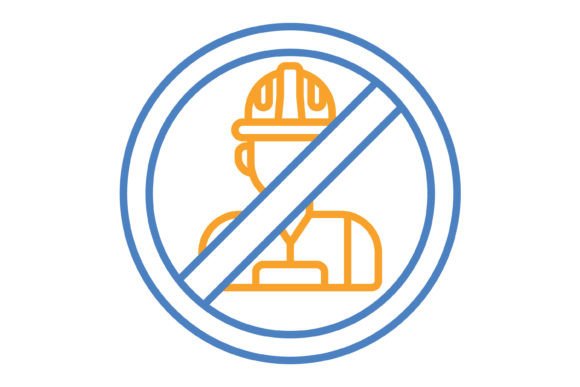
Visually, the icon presents a compelling duality. The "No Child Labor" motif typically relies on the universally understood symbol of a child—a simplified silhouette or abstract representation—paired with a prohibition marker. However, what sets this specific asset apart is its line-weight style and the strategic use of blue and orange. The blue grounds the design in trust and stability, often associated with corporate responsibility and institutional reliability. The orange injects urgency and energy without tipping into aggression. It draws the eye, signaling that this is an active stance against injustice. The line art style ensures that the icon does not feel heavy or oppressive; instead, it feels modern, open, and adaptable to various backgrounds. This aesthetic choice makes it suitable for everything from serious policy documents to dynamic social media campaigns.
Versatility in File Formats: AI, EPS, JPG, PNG, and SVG
One of the most frustrating experiences in design is finding the perfect visual asset only to discover it is locked in a format that doesn't fit your workflow. The inclusion of five different formats in this zip file—AI, EPS, JPG, PNG (Transparent Background), and SVG—addresses this pain point directly. This variety ensures that whether you are working in Adobe Illustrator for complex vector manipulation, building a website with HTML5, or assembling a quick presentation in Keynote, you have the right tool for the job.
The SVG (Scalable Vector Graphics) format is particularly critical for web designers and app developers. SVGs are code-based, meaning they load faster than raster images and scale infinitely without pixelation. This is essential for responsive web design where an icon needs to look crisp on a 4K monitor just as it does on a mobile screen. Conversely, the PNG file with a transparent background is the workhorse for content creators and marketers. It allows the icon to be dragged and dropped onto photographs, colored backgrounds, or video timelines without the hassle of removing white boxes or dealing with jagged edges. By providing these assets, the creator has effectively future-proofed the icon for a multi-platform workflow.
Practical Applications: From Brand Identity to Editorial Design
Understanding where to deploy the No Child Labor Blue & Orange Line Icon requires a grasp of visual hierarchy and context. For brand identity, specifically for NGOs, non-profits, or CSR (Corporate Social Responsibility) departments, this icon serves as a cornerstone asset. It can be used as a badge on packaging to denote ethical sourcing or as a favicon on a website to reinforce a commitment to human rights. In editorial design, such as magazine layouts or annual reports, the icon breaks up dense blocks of text, providing a visual anchor that summarizes the surrounding content.
Consider the realm of social media graphics. Platforms like Instagram and LinkedIn are crowded. A standard stock photo often gets scrolled past, but a sharp, high-contrast line icon in blue and orange can stop a thumb-scroll. It is distinct enough to stand out in a grid yet professional enough to maintain the credibility of the poster. Furthermore, for mobile apps, the icon’s "ready to use" nature means UI designers can integrate it into navigation bars or settings menus without extensive re-drawing. Its 100% vector nature ensures that it remains legible even at small sizes, a common pitfall with more detailed illustrations.
Integrating the Icon into Modern Typography and Layouts
While an icon is not a typeface in the traditional sense, it functions as a vital part of your typographic ecosystem. Good modern typography is about the interplay between text and white space, and icons are the punctuation marks of visual design. When pairing this icon with text, you should treat it like a display font—it needs room to breathe. Crowding the icon against a sans serif font can make the layout feel claustrophobic. Instead, use the icon in headers or margins to create visual rhythm.
For those working on packaging design, the icon offers a way to communicate complex compliance information quickly. Consumers are increasingly looking for ethical markers on products. Placing this icon near the barcode or ingredients list acts as a silent ambassador for the brand’s values. It works exceptionally well when the rest of the design utilizes a clean serif font or a geometric sans serif, allowing the icon's color palette to pop without clashing. The blue and orange are distinct enough to serve as accent colors, potentially tying into a broader color theory strategy where the blue represents the corporate entity and the orange represents the human impact.
Maximizing Usability and Editing Potential
The promise of "Easy to edit and scale" is a significant factor for creative professionals. Because the asset is 100% vector, you are not just buying a static image; you are buying a malleable design component. If your brand guidelines dictate a different shade of blue, or if you need the icon in monochrome for a specific print run, the AI and EPS files allow for complete customization. You can adjust stroke weights, change the fill colors, or even combine this icon with other design assets to create a new visual metaphor.
This level of flexibility is crucial for maintaining consistency across a brand identity. A logo design might use a simplified version of this icon, while a website might use the full-color version, and a presentation might use the monochrome SVG. The ability to edit the file ensures that the visual language remains coherent, regardless of the medium. For hobbyists and crafters, the transparency of the PNGs allows for easy integration into digital scrapbooking or print-on-demand merchandise, democratizing the ability to advocate for social causes through design.
A Strategic Asset for the Conscious Creator
Ultimately, the No Child Labor Blue & Orange Line Icon is a specialized but essential tool in the modern designer's kit. It moves beyond generic clip art to offer a premium font-level of utility for visual communication. By combining a thoughtful color palette, versatile file formats, and a scalable vector structure, it empowers creators to address serious topics with professionalism and clarity. Whether you are drafting a presentation for stakeholders, building a website for a charity, or designing templates for social media, this asset provides the visual authority needed to make a lasting impact.